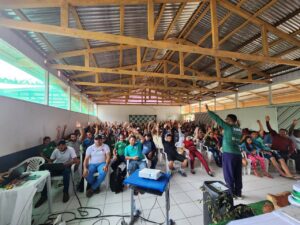
The event crowned years of voluntary work by the riverside communities of Itamarati and showed the population the results of sustainable management: fish in abundance, with high added value in taste, legalized, and that helps protect the municipality’s water and forest resources.
By: Nathália Messina and Neyde do Carmo
At the beginning of October, the riverside communities of Itamarati (Juruá River, Amazonas) inaugurated a new chapter in the municipality for nature conservation: the 1st fishing and sustainable management trade fair, focused on pirarucu and tambaqui, under the local Fishing Agreement. Held on the 2nd and 3rd at the Beira Rio Gymnasium, the communities achieved successful participation and sales, further strengthening more than 6 years of social work for the protection of fishing environments.
Officially approved in May 2025, the Itamarati Fishing Agreement moved from paper into practice and has already demonstrated its first major result. Even in an experimental phase, the fair showed, in practice, that it is possible to combine biodiversity conservation with income generation. More than a fish market, the event symbolized the strength of the social organization of nine riverside communities involved in this first management experience. In addition to the commercialization of fish, the program included educational, artistic-cultural, and political activities, reinforcing the collective commitment to consolidating sustainable management.
Knowledge, Culture and Commercialization
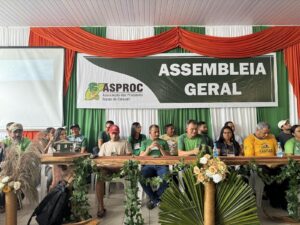
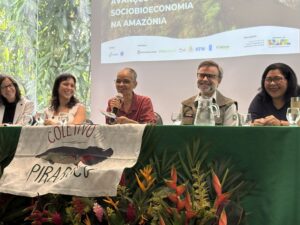
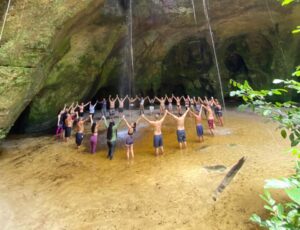
With the official opening on the evening of October 2, residents, authorities, students, artisans, and partners participated in a program dedicated to Culture and Socio-environmental Education, which included the screening of the documentary ‘Pirarucu, the Breath of the Amazon’, an exhibition of local handicrafts, and a lecture on the rules of the Fishing Agreement and the management of pirarucu. During the event, representatives of the Management Committee discussed future directions, reinforcing the collective commitment to conservation and the participatory management of fisheries resources. The evening concluded with moving tributes to the communities and a lively gathering.
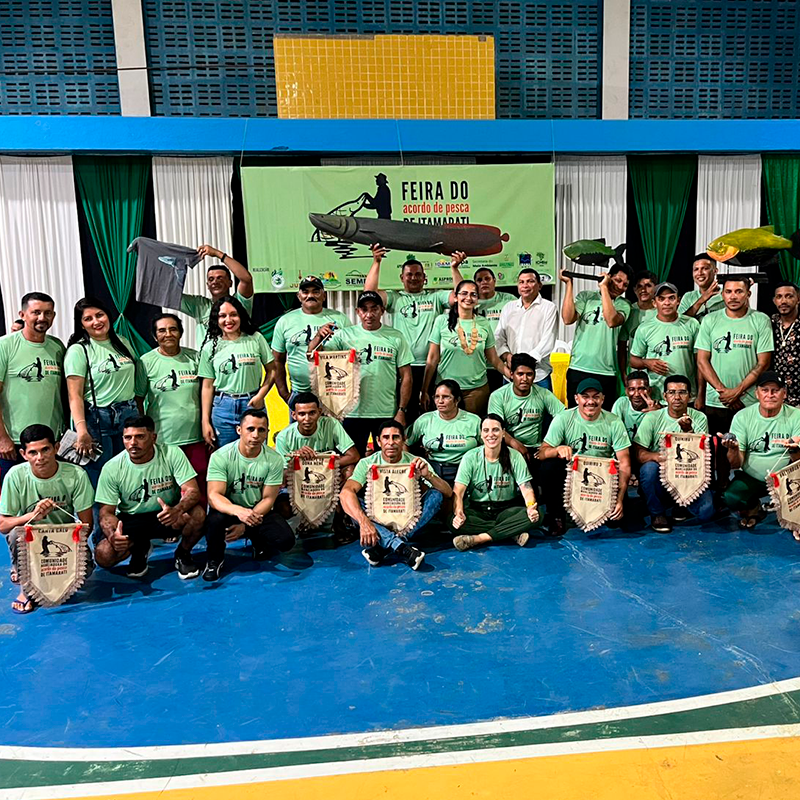
Photo: Indiara Bessa / Instituto Juruá Collection.
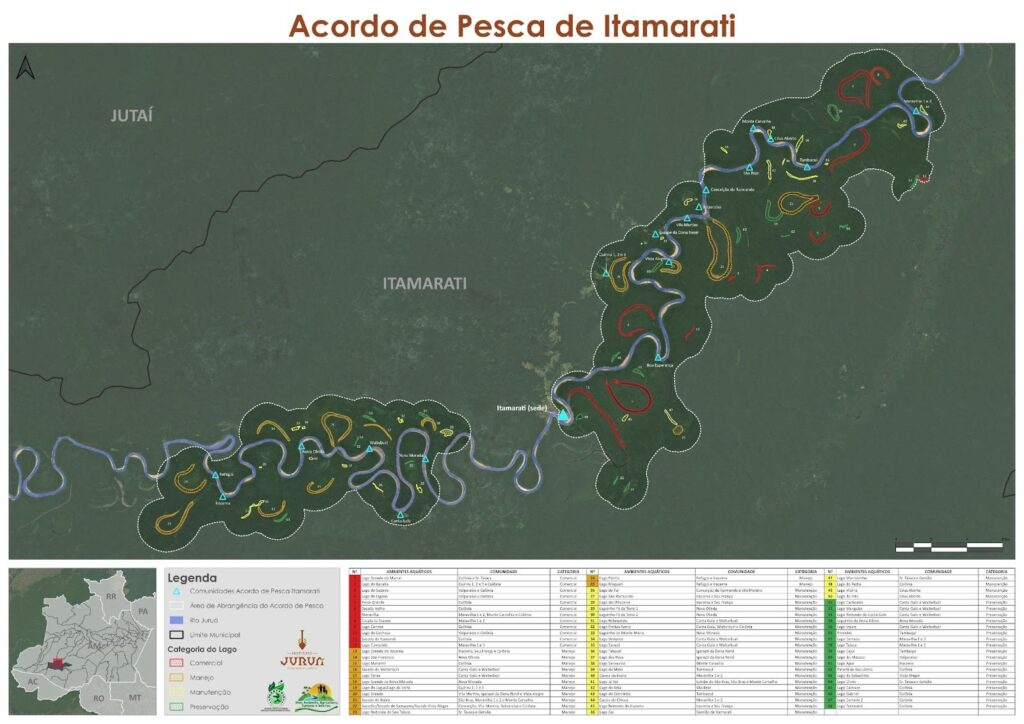
On the following day, even before dawn, a line was already forming at the entrance of the Gymnasium. At exactly 6 a.m., the sale of legally sourced managed fish from protected lakes began. Nine riverside communities took part in the process, organized into four management groups, distributed as follows: in the upper Itamarati area – São Francisco Lake (Nova Olinda Community); Tarira Lake and Sacado do Valterbury (Canta Galo and Valterbury Communities); in the lower Itamarati area – Lago Grande or Vista Alegre Lake (Vista Alegre, São Pedro, Vila Martins, and Igarapé da Dona Nenê Communities); and Jegue Lake (Quiriru 1 and Quiriru 3 Communities), as shown in Map 1 below.
Source: Pedro Lacerda / Instituto Juruá Collection.
The four management groups organized themselves into individual stalls, where approximately 283 kilograms of fresh pirarucus (5 units) and about 1.5 tons of tambaqui and other large fish were sold. All production was sold directly from the hands of community members to the final consumer – a strategy to strengthen the connection between those who fish responsibly and those who consume consciously.
In addition to the production sold at the fair, another 15 pirarucus (equivalent to 976 kg) and approximately 800 kg of tambaqui were sold to the Fishers’ Colony Z-59, which in turn allocated the fish to a social initiative organized by the Municipality of Itamarati, aimed at vulnerable populations.
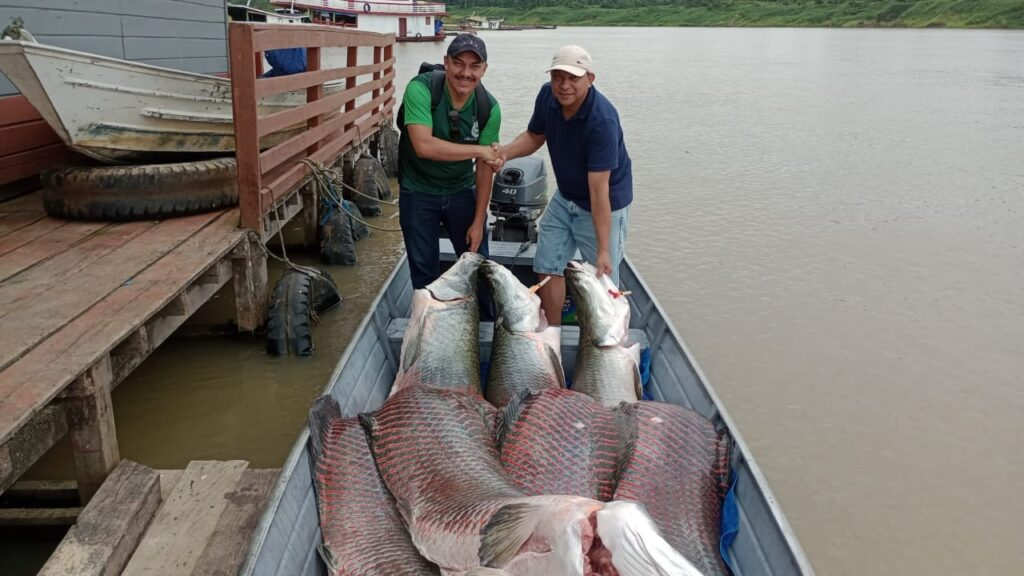
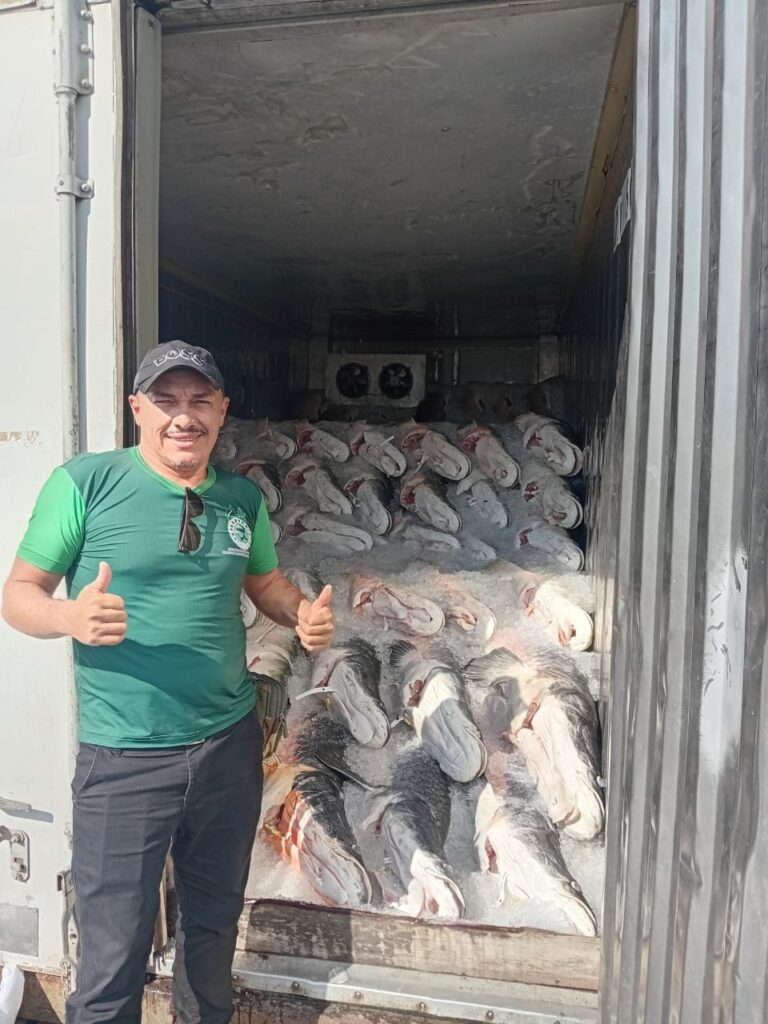
Photo: AAEPPRI Collection.
Sustainability that Bears Fruit
The success of the trade fair goes beyond sales. It demonstrates the effectiveness of the participatory co-management model in the management of lakes and aquatic environments, which combines traditional knowledge with technical-scientific protocols. The monitoring of the lakes, carried out for years on a voluntary basis and through a rotation system by the community members themselves, with technical assistance and support from partners, resulted in the increase of fish stocks, enabling this sustainable harvest that respects nature.
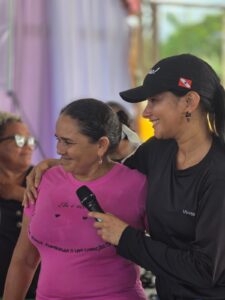
“The greatest gift I have received in my life is to be here today, after many struggles (…) and together with our partners. We are together, and thanks to God, much more will happen! I want to tell the population that it is worth conserving, because if we do not conserve, we will never get anywhere!” stated Mr. Chico Amâncio, vice president of AAEPPRI and one of the leading community leaders of Itamarati.
The legalized fish, sold with a receipt and a Transit Permit, guarantees consumers certainty of origin and contributes to increasing local revenue and community income, reinvesting in the sociobioeconomy cycle, as stated by Mr. Tarira, a leader from the Canta Galo community: ‘(…) our expectations go way up, because we see that this is work that is yielding results. So when you start working on something that you see is productive, your expectations go a thousand miles an hour, right?’, said Tarira in an interview with Instituto Juruá.
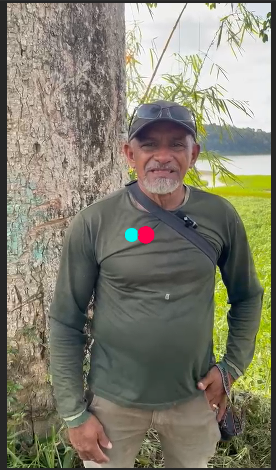
Photo: Indiara Bessa / Instituto Juruá Collection.
Positive Balance and Looking to the Future
The holding of the 1st Managed Fish Fair of the Itamarati Fishing Agreement was a practical demonstration that the Fishing Agreement should be strengthened. In addition to bringing quality food to the local population, the fair and the event around the management raised awareness in society about the importance of sustainable legal fishing and community-based conservation, generating direct income for the managing families and strengthening community unity around a common goal.
“Seeing them today with a completely different look and expression, with smiles on their faces, with recognition from institutions and with their level of representation where it is today, is very rewarding (…). For us, as an institution, (…) it is incomparable to see the return of this work, this seed that we have been planting since the beginning, from way back, together with Instituto Juruá,” expressed Nathanilson Lopes, Municipal Secretary of the Environment and one of the representatives of the Itamarati Fishing Agreement Committee.
The initiative was carried out by the Fishing Agreement Communities, AAEPPRI, Instituto Juruá, the Municipal Secretariat of the Environment, and the Municipal Secretariat of Production and Supply; and was supported by an extensive network of partners, including the Fishers’ Colony Z-59 (a member of the Management Committee), the Municipality of Itamarati, ICMBio, Ibama, ASPROC, AMARU, AMAB, and other institutions that are part of the Médio Juruá Territory Forum.
The success of this first event opens the way for the Managed Fish Fair to become a tradition in Itamarati, establishing itself as a symbol that it is possible to achieve quality of life and environmental conservation, from the perspective of strengthening Amazonian traditional peoples and communities.