A study reveals that these territories function as true networks of protection for biodiversity.
By: Camila Duarte Ritter
A new study published in the journal PNAS, led by a researcher from Instituto Juruá in collaboration with national and international partners, shows that Indigenous Lands (Terras Indígenas – TIs) and Protected Areas (Unidades de Conservação – UCs) are essential for maintaining connectivity in the Amazon. These territories not only protect the forest but also ensure the continuity of ecological processes that sustain life.
The research analyzed different regions of the Amazon and revealed that industrial threats, such as deforestation, mining, and large-scale developments, are not distributed uniformly. In some areas, ecosystems are already fragmented and isolated. But in others, where TIs and UCs predominate, the forest still preserves strong connectivity.
An emblematic example is the Juruá River, a sub-basin notable for its high connectivity. Its winding, well-preserved waters, together with the floodplain (várzea) and upland forests, form a true ecological corridor. This connectivity ensures the circulation of nutrients and the dispersal of animal and plant species, which are essential for biodiversity and the health of Amazonian ecosystems.
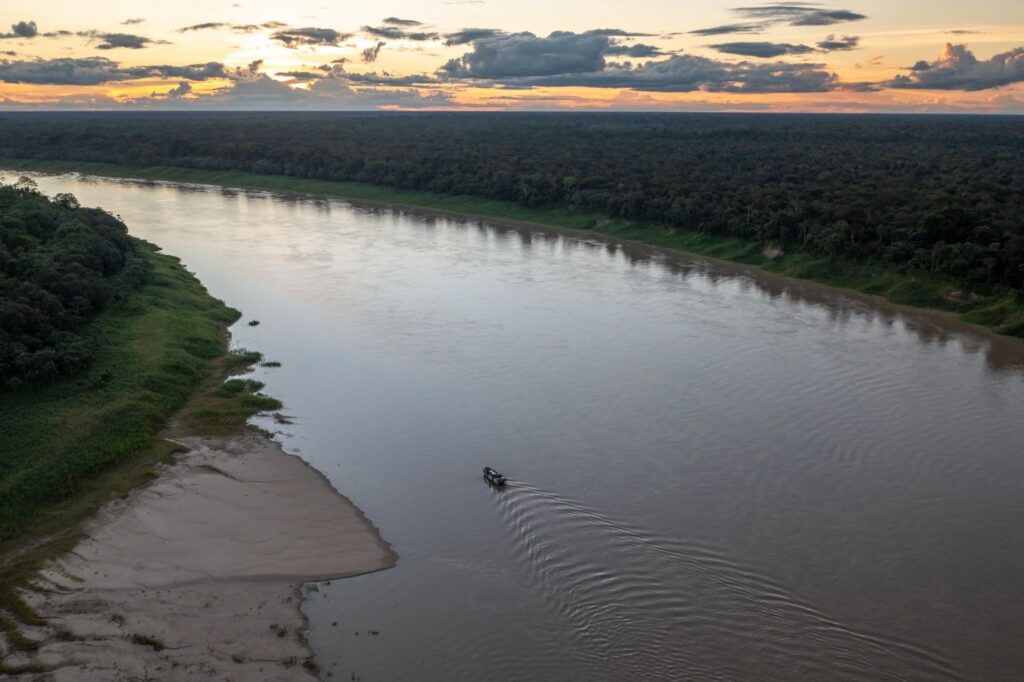
Photo: A boat glides along the Juruá River, one of the most interconnected waterways in the Amazon Basin. Photo credit: André Dib
The study also highlights that territorial protection is not solely about nature. The strong social organization of Indigenous and riverside communities plays a decisive role, linking environmental conservation with the well-being of local populations. The message is clear: preserving the Amazon depends as much on the strength of the forest as on the resilience and leadership of the people who live there.
This work reinforces the need to strengthen territorial rights and support community-based management, essential steps for a sustainable future for the Amazon, its rivers, forests, and peoples.
👉 Want to know more? Read the full article:
https://doi.org/10.1073/pnas.2418189122
Share this good news! Every time we highlight the importance of Indigenous peoples and local communities in conserving the Amazon, we strengthen the collective struggle for socio-environmental justice and a more sustainable future.