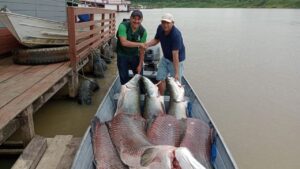
A iniciativa amplia a capacidade técnica local, valoriza o protagonismo comunitário e marca também o avanço da participação feminina na atividade
Por Indiara Bessa
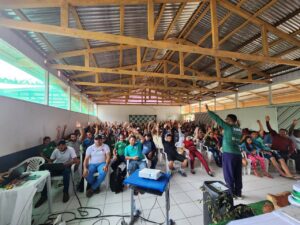
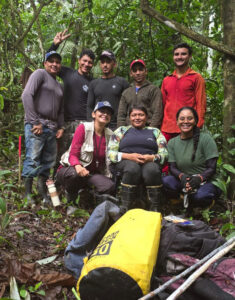
Between August 17 and 20, the Lago Serrado community, in the municipality of Carauari, Amazonas state, hosted a historic milestone for the Middle Juruá territory: the first edition of the pirarucu counter certification course in the region. The training brought together representatives from communities along the Juruá and Purus river basins and resulted in the certification of 17 new counters, including both men and women, expanding local technical capacity for monitoring this symbolic Amazonian species.
With this certification, communities strengthen their autonomy in participatory management, ensuring that annual fishing quotas are defined based on rigorous and reliable population surveys. The initiative was offered by the Instituto Juruá, with technical support from the Mamirauá Sustainable Development Institute (IDSM), a leading reference institution in Brazil.
Amazonian social technology spreading across the territory
The certification emerges as a natural next step following years of capacity-building activities led by the Instituto Juruá. For Simelvia Vida, the Institute’s Education and Community Strengthening Coordinator, this represents a strategic advance:
“As Instituto Mamirauá is a pioneer in training, we sought this partnership to bring the technology and have achieved excellence in delivering this course. The idea is to multiply this methodology, which is so important for the sustainability of fish stocks.”
Simelvia explains that up to that point, the region had only nine certified counters, which resulted in work overload and higher logistical costs. With the current training:
“We hope to decrease the time spent counting, reduce the effort required, and preserve the counters for the following stages of the management cycle, such as fishing.”
She also points to a medium-term outlook:
“This first edition was a pilot. Our intention is to repeat the course periodically, strengthen our local team, and spread the method ethically and responsibly. What matters is not counting more — it is counting the actual number the environment presents.”
Technical rigor and security in the certification process
The appraisal process combines theory, practice accumulated over the years and a technical stage, known as arrasto (drag-net assessment), which compares the visual counting by the counter with the real amount of the momentarily captured fishes by the net. The precision is fundamental: the error rate must not exceed 30%.
Ruiter Braga, technician at the Mamirauá Institute, was a member of the team responsible for the certification:
“Pirarucu counting is a population survey that serves as the basis for requesting fishing quotas from Ibama (Brazilian Institute of Environment and Renewable Natural Resources). We must ensure reliable counts, carried out with commitment and in accordance with a standardized methodology. Overestimating or underestimating can compromise the sustainability of fish stocks.”
According to him, the certification also provides greater confidence to the professionals responsible:
“When I was certified, I was finally able to answer the question: ‘Am I counting correctly?’ This assurance is fundamental. Now we expect increasingly reliable counters, replicating knowledge and maintaining results in line with the expectations for each environment.”
In this first edition, the spots were distributed democratically among community organizations, associations, areas where fishing agreements are expanding, and neighboring territories, ensuring that knowledge reaches different regions of the Amazon.
Community leadership and advancement of women’s participation
For residents and community leaders, receiving the certification in Lago Serrado represents recognition of the social organization of the territory. The pirarucu manager Fernanda Araújo de Moraes, a community resident and a leader of the movement, says that experiencing this achievement in the community was emblematic:
“Taking part in a certification course for counters here in Lago Serrado, in the fishing agreement area, was, for me, a moment beyond magical. We showed that we are organized in a way that earned us this certification in our community. And the most striking thing was seeing women certified as professional counters.”
Fernanda, who works to encourage women’s participation in all stages of the pirarucu value chain, highlights the impact of this mobilization:
“We often hear the phrase ‘counting is an activity for men,’ but I would never stay silent in the face of it. Women have the ability, strength, and knowledge to participate in any activity. Today they recognize their value, have an active voice, and show that they are essential within the territory.”
Why is counting decisive for the quota authorized by Ibama?
Pirarucu counting is considered the heart of management. Performed annually, it estimates the number of individuals of certain sizes present in the managed lakes. This population data is the basis that IBAMA uses to authorize legal fishing: according to current regulations, only a percentage of the detected adult animals may be captured — a conservation rule that prevents overfishing and ensures the natural regeneration of the stock.
When counting overestimates the actual number of fish, quotas may be inflated, posing a risk of population decline. When it is underestimated, the community loses income and management effort. Thus, precision is strategic: more than counting a lot of fish, it is about accurately counting what the environment can actually support. This responsibility makes the counter a key agent for the sustainability of the system.
Pirarucu management plan for the Middle Juruá region
Pirarucu participatory management is governed by federal regulations and involves a cycle of activities that is repeated annually. In this cycle, communities monitor and protect managed lakes, conduct population counts of pirarucu, prepare reports, and submit a fishing authorization request to Ibama. The environmental agency validates the submitted data and defines the quota — limited, proportional to the stock, and restricted to areas under formal fishing agreements.
In the Middle Juruá, this management has allowed the recovery of populations once drastically reduced by predatory fishing. Today, the managed territories show positive socio-environmental indicators: increased local income, greater food security, strengthened community governance, and recovery of aquatic environments. The model has become a reference for other regions of the Amazon due to the combination of traditional knowledge, continuous monitoring, community surveillance, and scientific criteria.