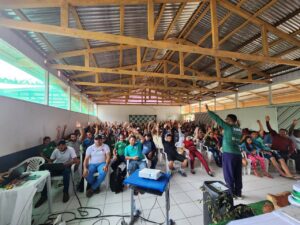
The meeting established itself as a milestone of political and supportive coordination among Amazonian women, united in the defense of sustainable development, gender equality, and environmental conservation.
By: Rebeca Vilhena/ Memorial Chico Mendes
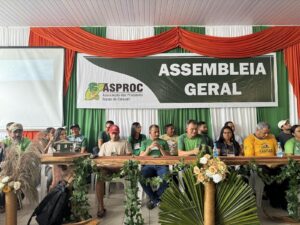
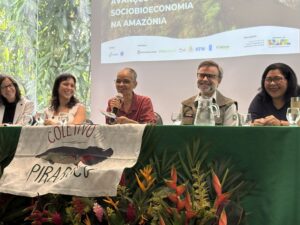
On October 17 and 18, 2025, Manaus hosted an unprecedented and transformative event: the Meeting of Female Leaders of Sociobioeconomy in the Amazon, which brought together around 60 extractivist women from different regions of the Amazon.
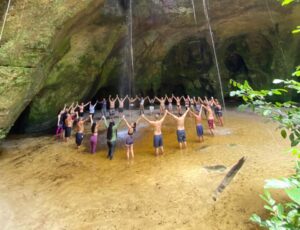
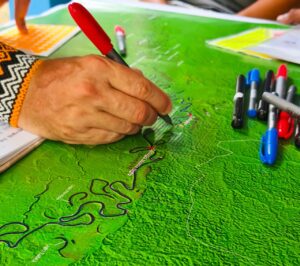
The event featured the participation of women representing collectives working in the management of pirarucu, açaí, flour, oilseeds, and rubber, coming from various territories of Amazonas. The program consisted of dialogue circles, workshops, debates, and cultural activities, providing two intense days of learning and network strengthening.
“This is a space created by women and for women, with the purpose of strengthening our voices, exchanging experiences, and inspiring new paths. And may this be just the first of many meetings, opening the way for more and more women to take the lead in building a more just, inclusive, and sustainable sociobioeconomy,” stated Maria Silva, Chief Financial Officer of the Memorial Chico Mendes.
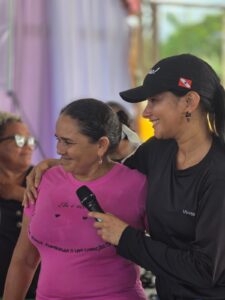
The meeting enabled a rich exchange of experiences, highlighting the leadership of women in the value chains of sociobioeconomy, one of the pillars for strengthening Amazonian communities. The participants reinforced the importance of the female role in all stages of the chain, from the collection and management of natural resources to governance, commercialization, and the transmission of traditional knowledge.
“It is extremely important for us to participate, because we learn a lot, gain a great deal of knowledge, and meet other people from different territories who are also working in the same struggle, with the same goal as us. Everyone works together to gain more strength, so that we are seen and recognized for our work, which is still not well acknowledged or properly represented in our territories,” stated Ivaneide Sousa, from the Pirarucu Collective.
The discussions also brought reflections on the remaining challenges in expanding women’s participation and visibility, such as unequal access to decision-making spaces, barriers in technical training, and the economic recognition of women’s work. From these exchanges, perspectives emerged on how women have been transforming the territories where they live and on collective paths to ensure more just and equal participation.
“Working in this sector is a challenge. We always need to be improving, staying up to date, and this exchange of experiences with other people helps us a lot. That’s why it is very rewarding to participate in this event and see everything that happens within our work, within the product,” shared Adriana Pereira.
Women also play an essential role in protecting Amazonian sociobiodiversity in the face of the risks that the territories currently face.
“This event showcased the active participation of women on the front lines in addressing current threats in the Amazon, such as mining, drug trafficking, deforestation, and other illegal activities in their territories. Bringing together diverse women from various locations in the same space recognizes this work and further amplifies its impact on the conservation of sociobiodiversity,” comments Ronnayana Silva, Coordinator of Territorial Programs at Sitawi.
The collective dialogue further reinforced the importance of female inclusion in the sociobioeconomy production chains, recognizing that the development of the Amazon will only be truly sustainable and just with the full participation of women.
“I met many people from different municipalities, and each experience shared here is very important to me. This will help me share what I learned with my partners who stayed back. Our work is with rubber, and here I found many people working with oil extraction, pirarucu fishing, and bio-jewelry… I am very happy and hope to have other opportunities like this,” said Lucineide Brito, from the Rubber Collective.
More than a training space, the meeting established itself as a milestone of political and supportive coordination among Amazonian women, united in the defense of sustainable development, gender equality, and environmental conservation.
“It is very important to be able to share these experiences and bring the positive aspects of this meeting to my region, to my territory, and share them with other women and with the entire collective involved in managed fishing. The experience has been very good; I am very happy to be here, meeting other women and other realities. Through the voices we are hearing here, we can strengthen ourselves and also strengthen our territories,” emphasized Iza Mura.
The initiative is the result of the collaboration between Memorial Chico Mendes, CNS (National Council of Extractive Populations), RFN (Rainforest Foundation Norway), Sitawi — via the Médio Juruá Territory Program —, WWF-Brazil, Natura, and Instituto Juruá, with the support of CETAM (Amazonas Center for Technological Education) and the Women’s Consulate.