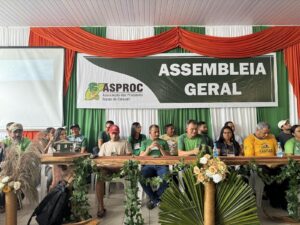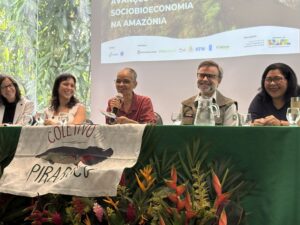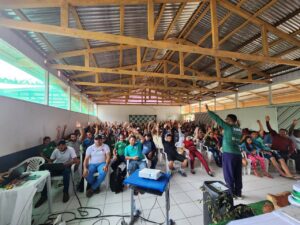
The Pirarucu Collective engaged in discussions with authorities in the federal capital about the Payments for Environmental Services policy and enforcement in management territories
By Talita Oliveira | OPAN
For nearly 10 years, even before officially consolidating as a Collective, male and female pirarucu managers from Amazonas have tirelessly brought to forums and meetings the need for greater territorial monitoring and the demand to be recognized for the environmental services they provide to the country. These services, rooted in their traditional ways of life and in the strict compliance with sustainable pirarucu management rules, generate systemic and lasting benefits for all of society.
In another advocacy action, made possible with the support of various partners, members of the Pirarucu Collective participated in the second edition of the Sociobiodiversity Week, held in early September in Brasília (DF). Beyond the event’s program, the male and female managers engaged in a series of dialogues with different public authorities, presenting the movement’s historic demands: territorial monitoring and the Payment for Environmental Services (Pagamento por Serviços Ambientais – PSA) policy.
“The Pirarucu Collective has been a very important platform for those who live in and conserve the forest. It has provided us with opportunities to engage in dialogue with government institutions and other non-governmental organizations. Speaking directly with the president of Ibama and with Minister Marina Silva regarding the protection of management areas was very important and historic,” emphasized Edvaldo Tavares, president of the Auati-Paraná Agroextractive Association (AAPA).
Payments for Environmental Services Policy
The workshop “Payments for Environmental Services (PSA) in Sociobioeconomy with a focus on pirarucu management in Amazonas,” held through a partnership between the National Secretariat for Bioeconomy of the Ministry of Environment and Climate Change (SBC-MMA) and the United Nations Development Programme (UNDP) under the Floresta + Amazônia project, took place at the headquarters of the Brazilian Institute of Environment and Renewable Natural Resources (Ibama) in Brasília, and presented to the managers the pilot PSA proposal for Sociobioeconomy focused on pirarucu management.
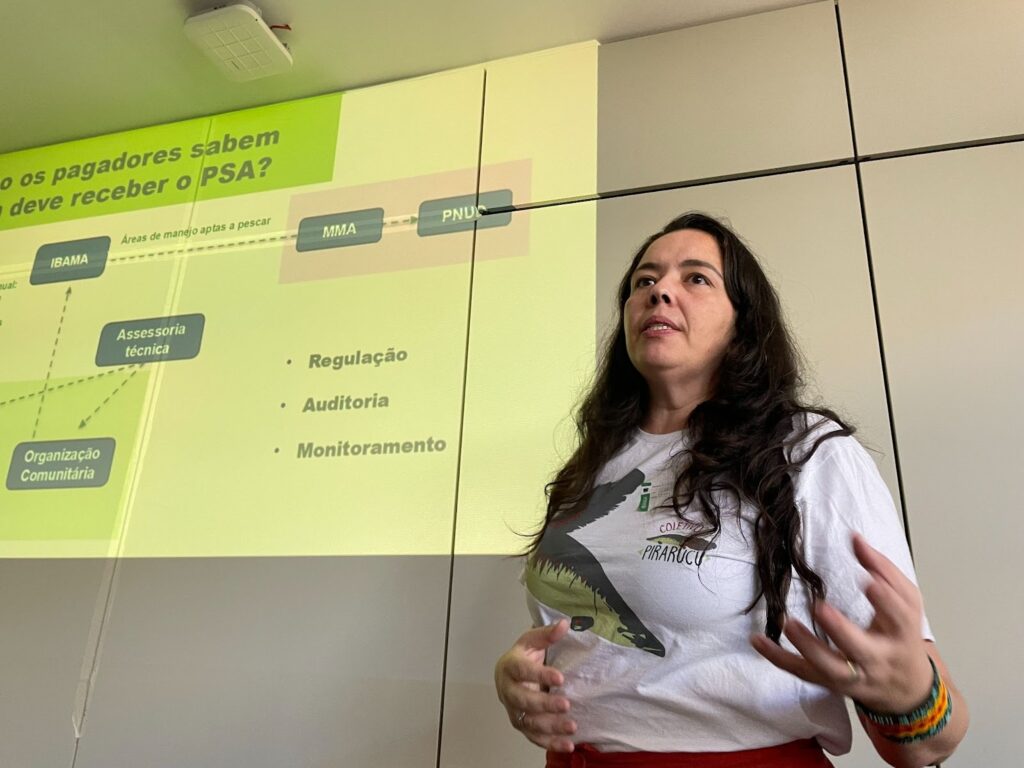
The initiative directly addresses a long-standing demand of the movement, which for years has sought recognition for the environmental services they provide to the country through pirarucu management. The National Secretariat of Bioeconomy at MMA, Carina Pimenta, emphasized the importance of the initiative and the partnership with the managers.
“Payments for Environmental Services are a historical demand of yours, and this project we are building will be emblematic for the regulation of the PSA policy. We want to regulate by creating concrete actions that link the policy to those who produce while protecting. The Pirarucu Collective is a great example of how this can happen, and I hope we can implement a viable arrangement that serves as a reference for other collectives in the future,” she stated.
Meeting with Minister Marina Silva
The Minister of Environment and Climate Change, Marina Silva, attended the opening of the PSA workshop and engaged in dialogue with members of the Collective. In her remarks, the minister shared her expectations regarding the pilot Payments for Environmental Services proposal presented by her ministry.
“The approach being taken here is a dream we’ve always had. It’s not just about carrying out command-and-control actions, it’s about tackling, whether illegal fishing or forest destruction, through public policies that can address these criminal activities in a structural way. This is the real change and the transformation that will be lasting,” concluded the minister.
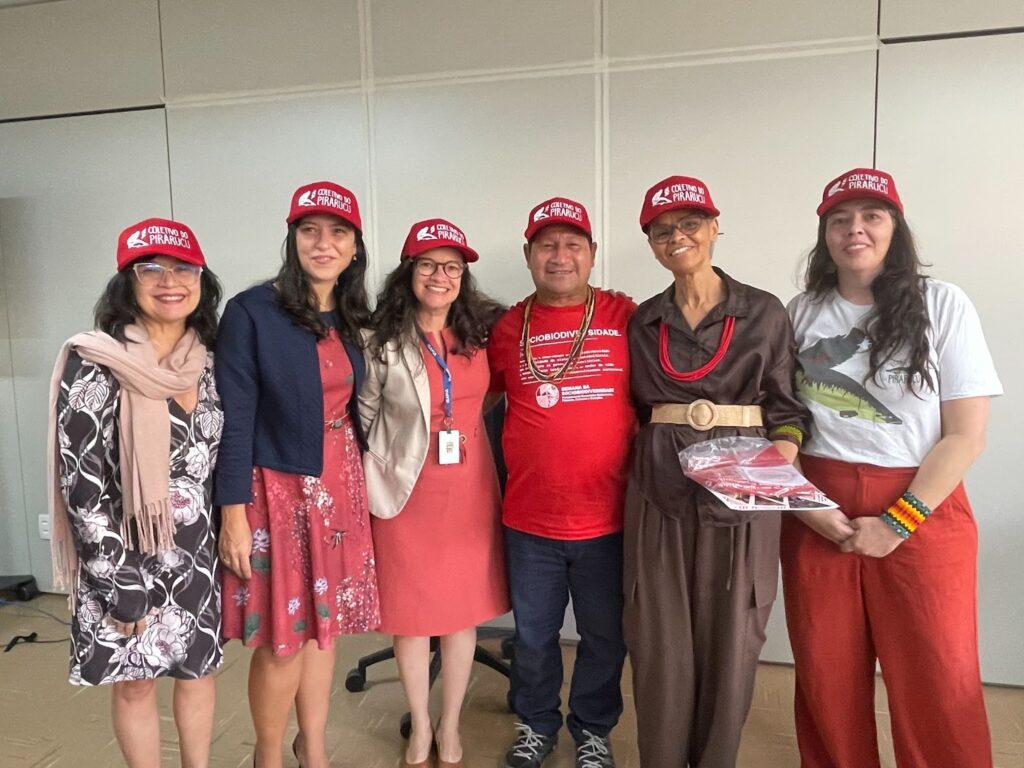
The presence of Marina, given her extractivist background, environmental advocacy, and international recognition, moved those in attendance. Pedro Canízio, Vice President of the Federation of Pirarucu Handlers (Femapam), could not hold back tears as he presented the minister with a cap from the Pirarucu Collective. Marina thanked him for the gesture. “This moment was very powerful. It is the strength of everything gathered here. You are people whose way of life is preservation itself,” said the minister.
Watch the video of the meeting here.
Monitoring in management territories
A recurring topic in discussions, monitoring in management territories was addressed comprehensively during a meeting held at the Ibama headquarters, attended by representatives from the Ministry of Justice and Public Security (MJSP), Ibama’s Fisheries Activity Monitoring Unit, ICMBio’s enforcement coordination, the United Nations Office on Drugs and Crime in Brazil, and the Federal Police. Through reports, data, studies, and a compilation of news items, authorities were presented with the territorial protection strategies implemented by the managing communities, as well as information on the increasing threats in these territories.
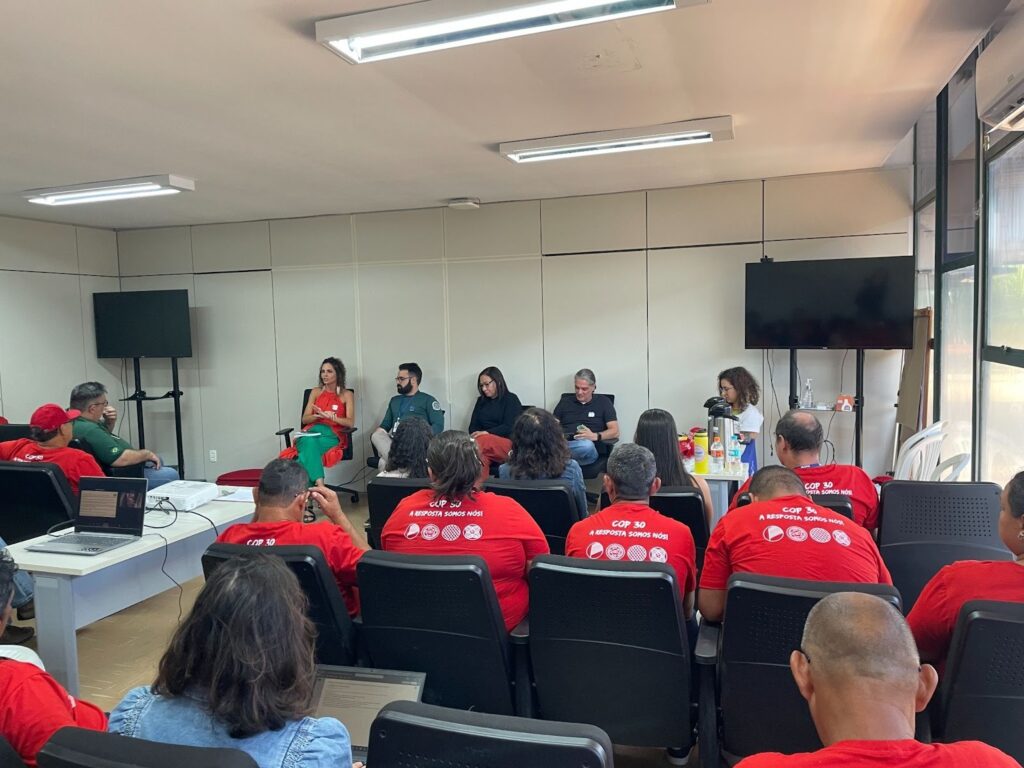
The debate extended throughout an entire afternoon, during which most of the time was occupied by the voices of the representatives of the communities present, as well as officials from agencies such as Ibama and the National Indigenous Peoples Foundation (Funai) operating in the municipalities closest to the territories, who brought accounts and reflections on the difficulties faced. “Listening spaces like this, where we hear your demands more than we speak about government actions, are very important. We need to listen, mobilize our institutions, and activate our peers so we can think about joint solutions,” reflected Lara Montenegro, coordinator of the Indigenous Peoples Strategy in the National Drug Policy Secretariat (Senad/MJSP).
Diogo Giroto, coordinator of the Amazonas program at Native Amazon Operation (Operação Amazônia Nativa – OPAN), evaluates that, although the responses of the agencies regarding the protection of the management territories currently are not satisfactory, the dialogue itself was positive. “We had the opportunity to convey the reality and the concern that we are having in the territories, mainly in the border regions, where we have seen a great escalation of problems such as drug trafficking and illegal mining. It was an initial dialogue that we managed to conduct, but it does not end in itself. More advocacy and actions will be necessary,” he concluded.
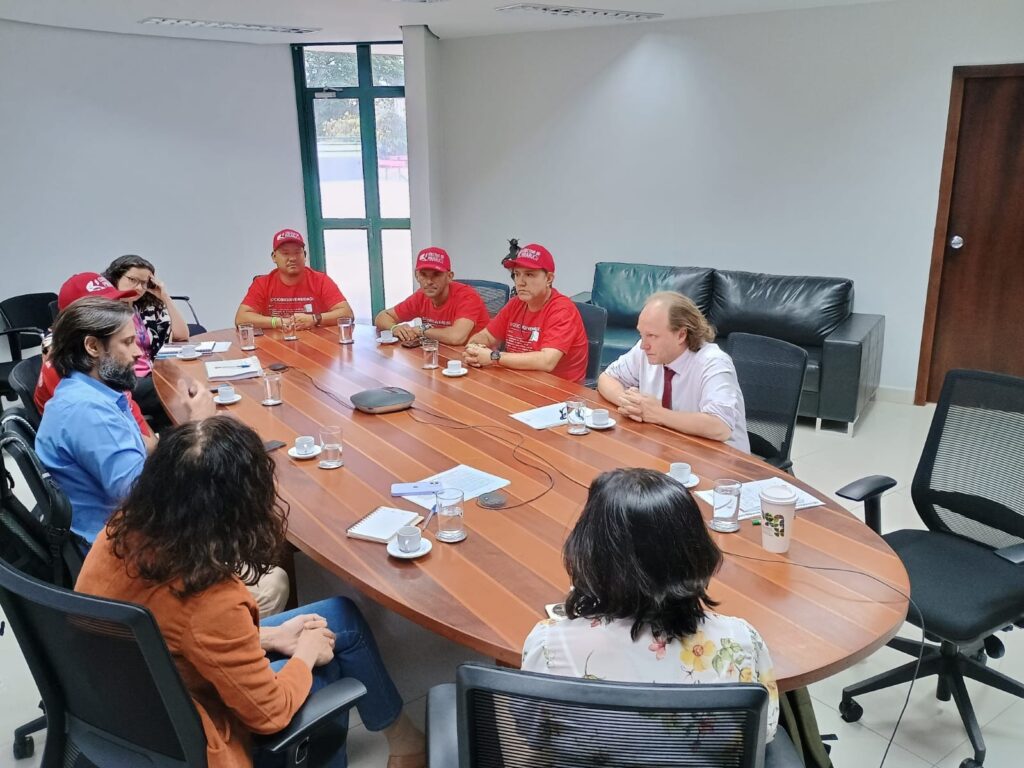
Still regarding enforcement, representatives of the Coletivo also met with the president of Ibama, Rodrigo Agostinho, bringing forward the complaints and demands of the managing communities. “He listened carefully to the manejadores and was moved; he understood that Ibama needs to engage more and provide stronger support for enforcement in the territories where management takes place. We were pleased because he genuinely committed to allocating more resources and inspection agents so that actions can be more intensive,” said Diomir de Souza Santos, secretary of the Association of Community Members Working with Sustainable Development in the Municipality of Jutaí (ACJ).
The agency’s president committed to improving intelligence strategies in coordination with Ibama’s Amazonas Superintendence. According to him, the goal is to bring the agency closer to the communities, making the processing of complaints faster and more effective. The measure aims to create a direct channel to the field, capable of enhancing enforcement actions and improving the response to the demands presented.
Partnerships
The participation of members of the Pirarucu Collective in the 2025 Sociobiodiversity Week was made possible with support from the United Nations Development Programme (UNDP), the Ministry of Environment and Climate Change, Ibama, the Association of Rural Producers of Carauari (Asproc), Fundo Vale, Operação Amazônia Nativa (OPAN), and the Amazon Waters Alliance, with support from the Gordon and Betty Moore Foundation and WCS.