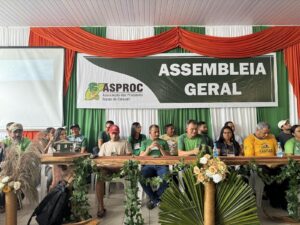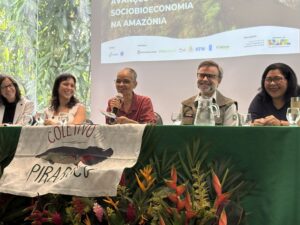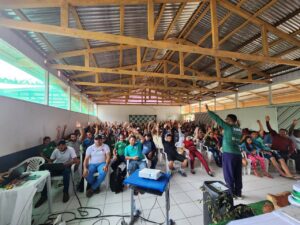
The document was collectively drafted during the Sociobiodiversity Week, which brought together around 450 representatives of extractive collectives in Brasília.
By Semana da Sociobiodiversidade
The Sociobiodiversity 2025 Letter, collectively drafted during the Sociobiodiversity Week, held in Brasília from September 1 to 5, was delivered to representatives of the Federal Legislative and Executive branches on Thursday (4) and Friday (5).
In the document, Indigenous peoples, quilombolas, traditional communities, extractivists, coastal-marine extractivists, and family farmers, gathered during Sociobiodiversity Week, emphasize their central role in addressing the climate crisis and contributing to the national economy, while demanding public policies suited to the realities of their territories. They also make it clear that they want space and voice at COP30, as well as effective recognition of their livelihoods and productive practices as promoters of climate regulation.
The event brought together around 450 representatives of extractive organizations from different regions of the country, working in socioproductive sectors such as rubber, pirarucu, Brazil nuts, and artisanal fishing in Marine and Coastal Extractive Reserves, among others. The letter is available on the website: cnsbrasil.org.
Among the main demands presented in the letter are:
– Territorial protection and land regularization;
– Financial and tax support, including the creation of Climate Insurance and the implementation of Payments for Environmental Services (PSA), among others;
– Expansion and adaptation of public policies;
– Adequate public policies on gender and youth;
– Guaranteed participation in COP30, in Belém, including involvement in debates and recognition of the peoples’ central role in addressing the climate crisis.
Dione Torquato, Secretary General of the National Council of Extractive Populations (CNS), points out that advancing in socio-environmental policy requires a tripod composed of an adequate State structure that can support traditional peoples and communities; a budget for the implementation of policies in the territories; and appropriate public policies.
“We have a shared agenda, which is the maintenance of our way of life, our cultures, and the understanding of our interrelation with the territory, but each of the traditional peoples has its own specificity. In the Amazon, there are several Amazons, as well as the Maretórios and in other biomes, and policies need to adapt,” he says.
Laura Souza, Executive Secretary of the Observatory of Sociobiodiversity Economies (ÓSocioBio), emphasizes the representativeness in the construction of the document: “This event brings together a great diversity of peoples, which ensures representativeness in the creation of the Sociobiodiversity Letter 2025, which presents demands directly from the territories, with realities and needs that urgently require appropriate policies, such as the Climate Insurance and PSA.”
Organized by the National Council of Extractive Populations (CNS) and the National Commission for Strengthening Coastal and Marine Extractive Reserves (CONFREM), in partnership with the Observatory of Sociobiodiversity Economies (ÓSocioBio), the week had the support of several institutions.